End2end Knowledge Vault
Trusted supply chain truth — defined, referenced, and translated into practical playbooks by End2End experts.
Access additional resources and insights

Business and Supply Chain Strategy
Last revised date:
1 October 2026
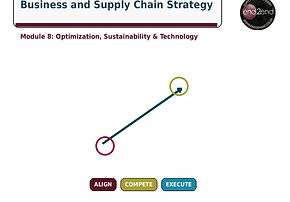
Supply chain strategy must align with organizational and business strategy. The supply chain then develops the capabilities needed to support competitive priorities, customer value and long-term objectives.
Business and Supply Chain Strategy

CSCP places supply-chain strategy inside a hierarchy of organizational, business and functional strategies. Misalignment between these levels can create conflicting priorities and wasted capability.
Why it matters
A supply chain optimized for the wrong competitive priorities can perform efficiently yet still fail the business. Strategy alignment ensures investment, capability and execution support what the organization is trying to achieve.
Core concepts
Organizational strategy defines the overall direction and sustainable competitive advantage the organization seeks.
Business strategy translates that direction into decisions about markets, products, competition and value creation.
Supply-chain strategy is a functional strategy that determines how supply capabilities will support business priorities.
Strategy formation includes strategic planning and business planning.
Business strategies can emphasize least cost, differentiation, focus or best cost.
Supply-chain capabilities should be assessed as current, needed and planned.
Strategies should be revisited as markets, technology, regulations and competitive conditions change.
Exam focus: Supply-chain strategy must align with business strategy.
Remember for the exam
Supply-chain strategy must align with business strategy.
Functional strategy supports higher-level organizational objectives.
Capabilities should reflect competitive priorities.
Strategy is dynamic and must adapt as conditions change.
Apply it
Use this concept in a practical decision by asking: Business and Supply Chain Strategy
Then check the decision against this principle: CSCP places supply-chain strategy inside a hierarchy of organizational, business and functional strategies. Misalignment between these levels can create conflicting priorities and wasted capability.
Exam trap
Watch for questions that test this distinction or principle: Supply-chain capabilities should be assessed as current, needed and planned.
Key takeaway
Supply chain strategy must align with organizational and business strategy. The supply chain then develops the capabilities needed to support competitive priorities, customer value and long-term objectives.
Related Articles:
Explore related articles that deepen the concept, connect the SCOR processes, and sharpen your practical application.
End-to-End Supply Chain Integration |
Supply Chain Ethics and Compliance |
Supply Chain Agility and Adaptability |
Integrated Business Planning and Decision Making |
Supply Chain Optimisation Tools and Models |
Emerging Technology Trends in Supply Chain |
Supply Chain Strategic Value and Optimisation |
Optimising Supply Chain Strategy and Tactics |
Business Continuity and Resilience |
Risk Responses and Mitigation Strategies |
Supply Chain Risk Management |
Technology Assessment and Implementation |
Emerging Technology Trends |
Sustainability Guidelines and Standards |
Sustainable Supply Chains |
Supply Chain Strategic Value and Optimization |
Business and Supply Chain Strategy |
Risk Responses, Action Plans and Business Continuity |
Risk Analysis |
Risk Registers and Risk Documentation |
Risk Identification and Supply Chain Risks |
Risk Management Frameworks for Supply Chain |
SRM Services and Procurement |
Supply Chain Relationship Management |
Supplier Certification |
Supplier Performance Measurement |
Supplier Performance Management |
Strategic Alliances and Alliance Development |
Single Sourcing vs Multisourcing vs Sole Sourcing |
Strategic Sourcing Using SRM |
Strategic Sourcing and Alliances |
Customer Relationship Management (CRM) |
Customer Segmentation and Customer Relationships |
Logistics Strategy and the Logistics Value Proposition |
Quality Tools and Continuous Improvement Methods |
Supplier Segmentation and Relationships |
Customer Service Metrics and Performance |
Customer Relationship Management |
Customer Segmentation and Customer Relationships |
Waste Hierarchy and Waste Management |
Reverse Logistics |
Trade Zones and Trade Blocs |
Import/Export Regulations and Documentation |
Distribution Services and Delivery Patterns |
Transportation Modes and Carrier Selection |
Transportation Strategy |
Materials Handling and Warehouse Operations |
Warehouse Location and Network Decisions |
Warehousing Strategy |
3PL vs 4PL Logistics Providers |
Logistics Strategy and the Logistics Value Proposition |
Quality Tools and Continuous Improvement |
Inventory Traceability, Accuracy and Disposition |
Inventory Replenishment Strategies |
Inventory Management Fundamentals |
Production Activity Control |
Capacity Management |
Materials and Inventory Planning |
Planning Operations |
Contracts and Purchase Orders |
Supplier Evaluation and Selection |
Supply Base Analysis and Right-Sizing |
Category Strategy for Sourcing |
Sourcing Requirements and Total Cost |
Make-versus-Buy, Outsourcing and Offshoring |
Financial and Operational Metrics |
Supply Chain Metrics and SCOR DS |
Supply Chain Master Data |
End-to-End Connectivity and Visibility |
Supply Chain Design and Network Optimisation |
Sales and Operations Planning (S&OP) |
Supply and Demand Alignment |
Measures of Forecast Error |
Forecasting Methods |
Forecasting Principles and Process |
End-to-End Supply Chain Planning Stack: Strategy to Execution |
Demand Analysis → Demand Management Loop: Turning Signals into Decisions (and Decisions into Learning) |
Performance and Continuous Improvement |
Keiretsu-Style Networks: |
Supply Chain Flows and Echelons |
Supply Chain Through the SCOR Lens (SCOR DS) |
Vertical and Horizontal Integration Models |
Product Life Cycle (PLC) |
Supply Chain Maturity |
The Bullwhip Effect |
Safety Stock |

Cheat Sheet
Exam Focus
Supply-chain strategy must align with business strategy.
Functional strategy supports higher-level organizational objectives.
Capabilities should reflect competitive priorities.
Strategy is dynamic and must adapt as conditions change.
Business and Supply Chain Strategy
Quotes of Wisdom
ASCM. (2026). CSCP Learning System, Version 5.4, Book 2 of 2, Module 8, Section A: Optimizing Supply Chain Strategy and Tactics — Business and Supply Chain Strategy.
Article Sources
Category:
SCOR Process:
Level:
Strategy & Governance
Orchestrate, Plan
Exam-Ready
Last Updated:
1 October 2026 at 22:05:59