
End2end Knowledge Vault
Trusted supply chain truth — defined, referenced, and translated into practical playbooks by End2End experts.
Access additional resources and insights

Safety Stock
Last revised date:
1 October 2026

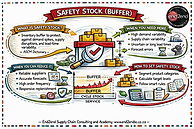
Safety stock is the inventory buffer that protects customer service when demand spikes, supply falters, or lead times wobble. Done right, it improves OTIF without quietly inflating working capital.
Safety Stock (Buffer): How to set it without overstocking

ASCM Dictionary definition:
“Stock planned to be in inventory to protect against fluctuations in demand or supply, including uncertainty, forecast errors, long lead times, or supplier shortages.” - (Source: ASCM Supply Chain Dictionary (19th edition).ASCM Dictionary- Updated - 19th edition)
What Safety Stock actually does (practical view)
Safety stock is not “extra inventory.” It is a risk buffer designed to absorb variability so that your cycle stock can be planned normally while service remains stable when reality deviates from the plan.
This video explains the concept in 3 minutes:
Source: Lokad: Safety Stock in 3 Minutes (https://www.youtube.com/watch?v=h6uO1mwgOrI)
Think of it as insurance you calibrate, not inventory you guess.
When you need more (and when you don’t)
You need more safety stock when:
Demand variability is high (promotions, seasonality, volatile customers)
Supply variability is high (supplier reliability issues, shortages, quality fallout)
Lead times are long or inconsistent
Forecast error is high or bias exists
You can reduce safety stock when:
Lead time variability is reduced (supplier performance + inbound visibility)
Forecast accuracy improves at the right level (SKU/location)
Replenishment frequency increases (smaller, more frequent orders)
You shift from “push” to more responsive pull/replenishment triggers
The key design decision: what are you protecting?
Choose ONE primary protection objective per SKU-class:
Customer service level/fill rate (most common)
OTIF (often used for key accounts)
Days of supply (useful for slower movers, but can hide inefficiency)
Production continuity (materials that can stop a line)
If you don’t pick the objective, you’ll end up buffering everything—and paying for it.
How it links to Reorder Point (ROP)
In an order point system, your trigger typically looks like:
** ROP = demand during replenishment lead time + safety stock
(ASCM Dictionary notes the order point is normally calculated as forecasted usage during replenishment lead time plus safety stock.) - ASCM Dictionary - 19th edition
How to size safety stock (clean “CSCP-ready” logic)
A common approach is service-level based safety stock:
** Safety Stock = z × σ(lead time demand)
Where:
- z = safety factor (service factor) tied to the target service level
- σ(lead time demand) = variability of demand over lead time (or forecast error scaled to lead time)
This is the “right direction” because it explicitly ties buffer to:
your desired service level
your actual volatility
Safety stock planning (what “good” looks like)
Safety stock planning is the process of identifying the correct inventory buffer to guard against stockout and meet desired service levels. - - (Source: ASCM Supply Chain Dictionary (19th edition).ASCM Dictionary- 19th edition)
A solid policy includes:
SKU segmentation (ABC/XYZ or margin/service criticality)
target service levels per segment
a review cadence (monthly/quarterly, depending on volatility)
exception rules (new items, intermittent demand, constrained supply)
Common mistakes (that quietly kill cash)
Setting “one-size-fits-all” days-of-cover buffers
Using average demand without variability
Ignoring lead time variability (supplier performance reality)
Not separating cycle stock vs safety stock in reporting
Reducing safety stock aggressively without improving drivers first
KPIs to track (so safety stock stays “healthy”)
Fill rate / OTIF by segment
Stockout frequency + duration
Forecast bias + error (MAPE/MAD)
Lead time mean + variability (supplier OTIF, lead time adherence)
Inventory turns + working capital trend
End2End practitioner shortcut
If service is poor and inventory is high, the issue is rarely “not enough safety stock.” It’s usually one of these:
wrong inventory placement (buffer in the wrong node)
bad replenishment parameters (lead time, MOQ, review period wrong)
forecast bias (systematic under-forecasting)
supplier variability not addressed (buffering symptoms)
Quick self-check questions
What variability dominates here: demand, supply, or lead time?
Which service metric are we protecting: fill rate, OTIF, or line continuity?
Are we buffering at the right location (DC vs plant vs supplier hub)?
Are lead times in the system reflecting reality—or contracts?
Did we segment SKUs or treat all items the same?
Want a practical safety stock calculator + segmentation template? Explore the End2End “Inventory Policy Toolkit” or join our CSCP support sessions for worked examples.
Why it matters
Safety stock is the inventory buffer that protects customer service when demand spikes, supply falters, or lead times wobble. Done right, it improves OTIF without quietly inflating working capital.
Core concepts
“Stock planned to be in inventory to protect against fluctuations in demand or supply, including uncertainty, forecast errors, long lead times, or supplier shortages.” - (Source: ASCM Supply Chain Dictionary (19th edition).ASCM Dictionary- Updated - 19th edition)
Safety stock is not “extra inventory.” It is a risk buffer designed to absorb variability so that your cycle stock can be planned normally while service remains stable when reality deviates from the plan.
This video explains the concept in 3 minutes:
Think of it as insurance you calibrate, not inventory you guess.
Demand variability is high (promotions, seasonality, volatile customers)
Supply variability is high (supplier reliability issues, shortages, quality fallout)
Remember for the exam
Safety stock: Stock planned to protect against fluctuations in demand or supply (uncertainty, forecast errors, long lead times, shortages).ASCM Dictionary- 19th edition
Safety factor (service factor): Numerical value used in the service function to provide a given customer service level. - ASCM Dictionary - 19th edition
Safety lead time: Time added to normal lead time to protect against lead time fluctuations.ASCM Dictionary-19th edition
Order point / Reorder point: Inventory level that triggers replenishment; normally, demand during lead time plus safety stock. ASCM Dictionary- 19th edition
Apply it
Use this concept in a practical decision by asking: Safety Stock (Buffer): How to set it without overstocking
Then check the decision against this principle: “Stock planned to be in inventory to protect against fluctuations in demand or supply, including uncertainty, forecast errors, long lead times, or supplier shortages.” - (Source: ASCM Supply Chain Dictionary (19th edition).ASCM Dictionary- Updated - 19th edition)
Exam trap
Watch for questions that test this distinction or principle: Safety stock is not “extra inventory.” It is a risk buffer designed to absorb variability so that your cycle stock can be planned normally while service remains stable when reality deviates from the plan.
Key takeaway
Safety stock is the inventory buffer that protects customer service when demand spikes, supply falters, or lead times wobble. Done right, it improves OTIF without quietly inflating working capital.
Related Articles:
Explore related articles that deepen the concept, connect the SCOR processes, and sharpen your practical application.
End-to-End Supply Chain Integration |
Supply Chain Ethics and Compliance |
Supply Chain Agility and Adaptability |
Integrated Business Planning and Decision Making |
Supply Chain Optimisation Tools and Models |
Emerging Technology Trends in Supply Chain |
Supply Chain Strategic Value and Optimisation |
Optimising Supply Chain Strategy and Tactics |
Business Continuity and Resilience |
Risk Responses and Mitigation Strategies |
Supply Chain Risk Management |
Technology Assessment and Implementation |
Emerging Technology Trends |
Sustainability Guidelines and Standards |
Sustainable Supply Chains |
Supply Chain Strategic Value and Optimization |
Business and Supply Chain Strategy |
Risk Responses, Action Plans and Business Continuity |
Risk Analysis |
Risk Registers and Risk Documentation |
Risk Identification and Supply Chain Risks |
Risk Management Frameworks for Supply Chain |
SRM Services and Procurement |
Supply Chain Relationship Management |
Supplier Certification |
Supplier Performance Measurement |
Supplier Performance Management |
Strategic Alliances and Alliance Development |
Single Sourcing vs Multisourcing vs Sole Sourcing |
Strategic Sourcing Using SRM |
Strategic Sourcing and Alliances |
Customer Relationship Management (CRM) |
Customer Segmentation and Customer Relationships |
Logistics Strategy and the Logistics Value Proposition |
Quality Tools and Continuous Improvement Methods |
Supplier Segmentation and Relationships |
Customer Service Metrics and Performance |
Customer Relationship Management |
Customer Segmentation and Customer Relationships |
Waste Hierarchy and Waste Management |
Reverse Logistics |
Trade Zones and Trade Blocs |
Import/Export Regulations and Documentation |
Distribution Services and Delivery Patterns |
Transportation Modes and Carrier Selection |
Transportation Strategy |
Materials Handling and Warehouse Operations |
Warehouse Location and Network Decisions |
Warehousing Strategy |
3PL vs 4PL Logistics Providers |
Logistics Strategy and the Logistics Value Proposition |
Quality Tools and Continuous Improvement |
Inventory Traceability, Accuracy and Disposition |
Inventory Replenishment Strategies |
Inventory Management Fundamentals |
Production Activity Control |
Capacity Management |
Materials and Inventory Planning |
Planning Operations |
Contracts and Purchase Orders |
Supplier Evaluation and Selection |
Supply Base Analysis and Right-Sizing |
Category Strategy for Sourcing |
Sourcing Requirements and Total Cost |
Make-versus-Buy, Outsourcing and Offshoring |
Financial and Operational Metrics |
Supply Chain Metrics and SCOR DS |
Supply Chain Master Data |
End-to-End Connectivity and Visibility |
Supply Chain Design and Network Optimisation |
Sales and Operations Planning (S&OP) |
Supply and Demand Alignment |
Measures of Forecast Error |
Forecasting Methods |
Forecasting Principles and Process |
End-to-End Supply Chain Planning Stack: Strategy to Execution |
Demand Analysis → Demand Management Loop: Turning Signals into Decisions (and Decisions into Learning) |
Performance and Continuous Improvement |
Keiretsu-Style Networks: |
Supply Chain Flows and Echelons |
Supply Chain Through the SCOR Lens (SCOR DS) |
Vertical and Horizontal Integration Models |
Product Life Cycle (PLC) |
Supply Chain Maturity |
The Bullwhip Effect |
Safety Stock |

Cheat Sheet
Safety Stock - Cheat Sheet:
Safety stock: Stock planned to protect against fluctuations in demand or supply (uncertainty, forecast errors, long lead times, shortages).ASCM Dictionary- 19th edition
Safety factor (service factor): Numerical value used in the service function to provide a given customer service level. - ASCM Dictionary - 19th edition
Safety lead time: Time added to normal lead time to protect against lead time fluctuations.ASCM Dictionary-19th edition
Order point / Reorder point: Inventory level that triggers replenishment; normally, demand during lead time plus safety stock. ASCM Dictionary- 19th edition
Safety Stock
Quotes of Wisdom
"Make inventory a common enemy for your company" - Dave Walters
Definitions: ASCM. (2025). ASCM Supply Chain Dictionary (19th ed.) [Reference]. Accessed 2026-02-19.
Supply Chain Safety Stock video: Vermorel, J. (2007, Dec; revised 2012, Jan). Safety Stock [Webpage]. Lokad. Accessed 2026-02-19. https://www.lokad.com/calculate-safety-stocks-with-sales-forecasting
Article Sources
Category:
SCOR Process:
Level:
Inventory Management
Plan, Source, Fulfill, Return, Orchestrate
Exam-Ready
Last Updated:
1 October 2026 at 22:06:54